
Free Kundli
Tell Me My Janam Kundali — Free, by Date of Birth
Ask AI Jyotishi a Question
Receive an immediate Vedic astrological answer analyzed against your planetary positions and current Dasha.
See how to read your kundali
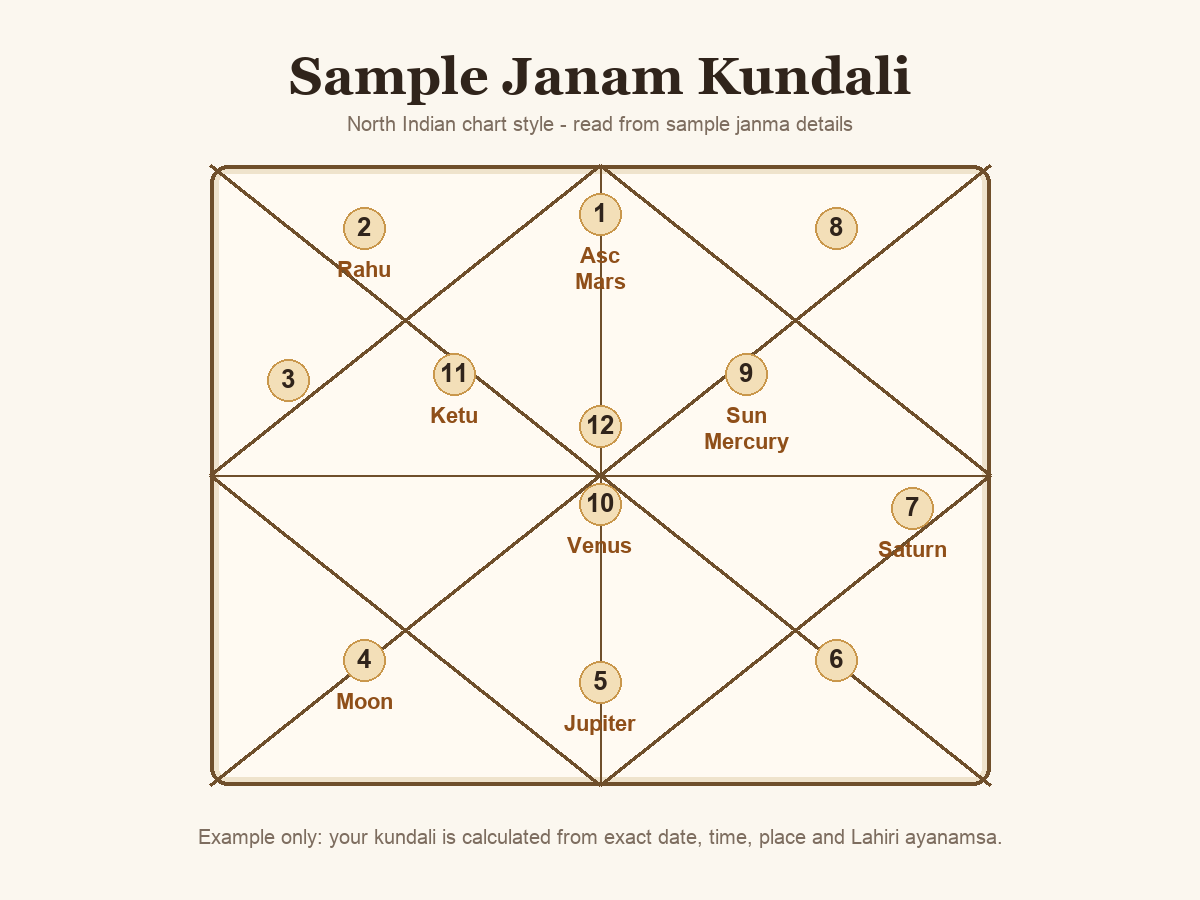
- Check the birth details before reading the diagram. An incorrect time changes what the chart can support.
- In this North Indian layout, distinguish the house position from the sign label. Read each graha with both labels rather than treating a number as a prediction.
- Compare the diagram with the planetary table in your result. Ask which placement supports the interpretation and what remains uncertain.
Missing birth time? Use the reduced reading; this illustration does not supply your Lagna or houses. For a question about the explanation, continue with your chart in the AI astrology chat. Read the calculation method.
Two kundali websites disagree? Compare these first
Before deciding that a chart is wrong or choosing another upay, compare the same inputs. Keep both planetary tables open and note where the difference begins.
- Birth details: Match the date, AM or PM, and the selected birthplace on both charts. Keep a family estimate marked as uncertain rather than treating it as an exact time.
- Calculation settings: Compare the timezone, ayanamsa and zodiac settings. Changing the drawing style alone should not change the underlying planetary table.
- Planetary table: Compare each planet's sign and displayed degrees first, then its house. Read the legend: a number in one chart layout may label a sign rather than a house.
- Interpretation: If the calculations agree but the readings differ, ask which Jyotish rule and combination supports each reading. Matching calculations do not guarantee a prediction.
Read one planetary-table row at a time: the graha, its sign and degrees, then its house. A sign number is not a house number. If you only need your Moon sign, use the Rashi calculator; a full kundali also needs the Lagna and house context.
Compare calculated Ascendant, Moon sign and nakshatra across your possible birth times
Without a known birth time, agreement about exact Lagna, houses or Dasha timing is not reliable evidence. Recheck time-dependent conclusions when a birth record becomes available. Use the step-by-step kundali comparison checklist
AI Kundali Analysis
Why does this pattern keep repeating in your life?
Your kundali names the house, planet, and dasha behind it. Then it gives the upay you can actually follow.
Ask your chart: Which pattern in my kundali is affecting me the most?
What your kundali report will show
- Which house and planet explain the pattern you keep seeing.
- How your active dasha changes the timing of career, marriage, and money.
- Which upay fits your chart before you guess or overspend.
Free · No login needed
What is Kundli (Janam Kundali)?
A Kundli — also called Janam Kundali (जन्म कुंडली) or Vedic birth chart — is a celestial map drawn for the exact moment and place you were born. Rooted in Jyotish Shastra, an astronomical tradition refined over thousands of years in India, the kundli captures the positions of the Navagraha (nine planets: Sun, Moon, Mars, Mercury, Jupiter, Venus, Saturn, Rahu, and Ketu) across the 12 bhavas (houses) of your chart. Each bhava governs a specific area of life — from personality and wealth to relationships, career, and moksha.
The foundation of every kundli is the Lagna (Ascendant), which is the zodiac sign rising on the eastern horizon at your birth moment. This determines the layout of all 12 houses and how the planets influence your life. Traditional astrologers also study the Rashi chart (D-1), Navamsha chart (D-9), and other divisional charts for deeper insight. Doshas such as Mangal Dosha, Kaal Sarp Dosha, and Sade Sati are identified by analysing specific planetary placements and combinations.
Our free kundli software uses Swiss Ephemeris with Lahiri Ayanamsa to calculate sidereal planetary positions. Check the displayed degrees and birth settings before interpreting the chart. The AI explains those calculated facts using Vedic tradition; it does not replace an experienced Jyotishi or establish that a prediction will happen.
How Our Free Kundli Software Works
Step 1 — Enter your birth details: Provide your date of birth, time of birth (if known), and birth place. The birth place is geocoded to precise latitude, longitude, and timezone so planetary positions can be calculated for your exact location.
Step 2 — Swiss Ephemeris calculation: Our backend computes the sidereal longitude of all nine Vedic planets using the Swiss Ephemeris library with Lahiri Ayanamsa correction. The planetary table lets you inspect the result and compare it using the same birth and calculation settings.
Step 3 — Rules and explanation: The calculation engine derives supported chart factors from your birth details. AI receives those facts and explains their traditional meaning; it does not invent positions or calculate your dosha score. Exact houses and timing require a reliable birth time.
Step 4 — Personalised interpretation: You receive a detailed reading in English or Hindi covering personality traits, career direction, relationship insights, and spiritual guidance — along with recommended remedies and Ishvaram products aligned to your chart.
After the chart is generated, continue into the free astrology chat to ask follow-up questions about the planets, dosha, dasha timing, marriage, career, or upay shown in your kundli.
Shodashvarga Divisional Charts (D1, D9 Navamsha, D10 Dashamsha)
Check divisional micro-charts for marriage and spouse traits (D9 Navamsha), career trajectory (D10 Dashamsha), and progeny (D7 Saptamsha).
💍 D-9 Navamsha (नवांश चक्र)
1/9th Division (3°20')Signifies: Marriage, spouse traits, inner dharma & post-30 destiny
D-9 (नवांश चक्र) Chakra
Lagna / Self: Core constitution, identity and life trajectory in this division.
Click any house in the chart above to inspect its specific Vedic portfolio.
Key Life Domains Examined
- •Spouse's temperament and marital compatibility
- •Dharmic purpose and hidden soul strength
- •Planetary potency (Vargottama / Pushkar Navamsha)
Primary Karaka Grahas
Venus (Shukra), Jupiter (Guru), 7th Lord
Classical Jyotishi Rule
A planet exalted in D1 but debilitated in D9 loses its real-world delivery power; check Vargottama status.
How to Generate Your Free Kundali — Step by Step
Generating your janam kundali takes under two minutes. Follow these steps to get your complete Vedic birth chart with accurate planetary positions, dosha analysis, and AI-powered interpretation.
- 1
Enter your full name
Type your full name as you would like it to appear on the kundali report. The name is used for the chart header and personalised interpretation.
- 2
Enter your date of birth
Select or type your date of birth (day, month, year). Accurate date of birth is required for all planetary position calculations in the janam kundali.
- 3
Enter your exact time of birth
Provide the time of birth as precisely as possible — ideally from a birth certificate or hospital record. Birth time affects Lagna, houses and Dasha timing. If unknown, select 'Time unknown' for a reduced reading without exact houses or timing claims; do not enter a guessed time.
- 4
Enter your place of birth
Type your city or town of birth. The system automatically geocodes it to the precise latitude, longitude, and timezone required for Swiss Ephemeris calculations.
- 5
Click Generate Kundali
Click the Generate button. Our backend computes all nine planetary positions using the Swiss Ephemeris with Lahiri Ayanamsa correction, then identifies your Lagna, Rashi, Nakshatra, active Dasha period, doshas, and yogas.
- 6
Review your chart and AI interpretation
Your free janam kundali is displayed in North or South Indian chart style (select your preference). Scroll below the chart for a personalised AI-powered interpretation covering personality, career, relationships, and dasha timing. Traditional upay (remedies) are listed where relevant.
How to Read Your Kundali After It Is Generated
Start with the Lagna chart, because it shows how the whole birth chart is arranged around you. The first house describes your body, temperament, confidence, and the way life opens for you. The seventh house shows partnership and marriage patterns. The tenth house shows karma, profession, public work, and the kind of responsibility you are repeatedly asked to carry. When a planet sits in a house, it colours that life area. When a planet aspects a house, it influences that life area from a distance. This is why two people with the same Rashi can live very different lives: the Lagna, house lordship, aspects, and Dasha timing change the meaning.
Next, look at the Moon sign and Nakshatra. The Moon shows your inner rhythm, emotional pattern, comfort needs, and how the mind reacts during pressure. Nakshatra gives a finer layer: it tells you the instinct behind the Rashi. For example, two people may both have Moon in Vrishabha, but a Rohini Moon and a Mrigashira Moon will not express the same hunger, attachment, or curiosity. This is also where many practical upay begin. A Jyotishi may strengthen the Moon through mantra, fasting, daan, or daily routine only after checking whether the Moon is weak, afflicted, or simply active in a difficult Dasha.
Then read the Vimshottari Dasha. Dasha is the timing engine of Jyotish. A chart may promise learning, marriage, travel, or career rise, but Dasha tells when that promise becomes active. The Mahadasha shows the larger chapter of life. The Antardasha shows the current sub-theme. Transit adds the moving weather around that period. This is why Ishvaram does not treat a kundali as a static personality report. A good reading connects the birth promise with current timing: which graha is active, what house it owns, where it sits, whether it is supported by benefic influence, and what action is sensible now.
Finally, use dosha and yoga results with care. Mangal Dosha, Kaal Sarp Dosha, Sade Sati, Pitru Dosha, Kemadruma Yoga, Raj Yoga, and Dhana Yoga are not labels to fear or celebrate blindly. Each one needs strength, cancellation, house context, and Dasha relevance. A dosha that is not active in timing may be background pressure. A yoga that is promised in the chart may still need the right Dasha and practical effort to show results. The useful question is not "is this good or bad?" The useful question is: "what is active now, what should I avoid, and what upay or action brings the chart back into balance?" This keeps the reading practical, grounded, and useful for real decisions.
This is also why Kundali, Panchang, Choghadiya, Muhurat, and Rahu Kaal should work together. Kundali explains your personal karma and tendencies. Panchang explains the quality of the day. Muhurat chooses the right window for beginning something important. Choghadiya gives a quick daily timing layer for ordinary decisions. Rahu Kaal tells you when not to start major work. The strongest guidance comes when the chart, the current Dasha, and the day's Vedic timing point in the same direction.
12 Bhavas / Houses in a Kundali
A Jyotishi does not read grahas in isolation. Rashi shows the sign, but the house shows where that graha gives its result in life. Use this table while reading your free kundali so every placement has its bhava context.
| House | Classical name | Life area | How to read it |
|---|---|---|---|
| 1st house | Lagna / Tanu Bhava | Body, temperament, confidence, how life opens for you | A Jyotishi starts here before judging body, nature, health tendency, and chart strength. |
| 2nd house | Dhana Bhava | Family, speech, savings, food habits, stored wealth | Shows dhan retention, family sanskar, and the tone carried by your speech. |
| 3rd house | Sahaja Bhava | Courage, siblings, skills, communication, short travel | Shows parakram: effort, initiative, skill-building, writing, and business outreach. |
| 4th house | Sukha Bhava | Mother, home, property, vehicles, inner comfort | Read for sukh: mother, home, education roots, property, and domestic shanti. |
| 5th house | Putra Bhava | Children, intelligence, mantra, romance, past-life punya | Key for buddhi, mantra, children, attraction, and past-life punya. |
| 6th house | Ripu Bhava | Debt, disease, enemies, service, daily discipline | Shows roga, rin, and shatru patterns: where discipline turns pressure into strength. |
| 7th house | Yuvati Bhava | Marriage, partnership, contracts, public dealing | Primary house for vivah promise, business partners, and repeating relationship karma. |
| 8th house | Ayush Bhava | Longevity, sudden change, inheritance, hidden matters | Read carefully for ayush, sudden change, hidden matters, and deep karmic shifts. |
| 9th house | Dharma Bhava | Father, guru, fortune, dharma, higher learning | Shows bhagya, guru kripa, pilgrimage, and the chart's dharmic support. |
| 10th house | Karma Bhava | Career, public status, responsibility, authority | Read for profession, recognition, zimmedari, and the karma that keeps returning. |
| 11th house | Labha Bhava | Gains, networks, elder siblings, fulfilment of desire | Shows labh: income channels, networks, and whether effort converts into gain. |
| 12th house | Vyaya Bhava | Expenses, foreign lands, sleep, moksha, isolation | Important for vyaya, sleep, foreign lands, moksha, retreat, and endings. |
The 9 Grahas (Navagraha) in Your Kundali
Every kundali is built from the nine grahas. Each planet is a karaka (significator) of certain life themes, and each rules one or two of the 12 rashis. When you read a placement, ask two things: what does this graha signify, and which houses does it rule from its own signs? That is how a Jyotishi turns a position into meaning.
| Graha | Signifies (karaka) | Rules (rashi) |
|---|---|---|
| Sun | Soul, Father, Authority, Government, Health, Vitality, Ego | Leo |
| Moon | Mind, Mother, Emotions, Fertility, Public, Travel | Cancer |
| Mars | Energy, Courage, Siblings, Land, Surgery, Accidents, Anger | Aries, Scorpio |
| Mercury | Intelligence, Communication, Trade, Education, Writing, Skin | Gemini, Virgo |
| Jupiter | Wisdom, Children, Wealth, Dharma, Guru, Expansion, Fortune | Sagittarius, Pisces |
| Venus | Love, Marriage, Beauty, Art, Luxury, Vehicles, Comfort | Taurus, Libra |
| Saturn | Discipline, Karma, Longevity, Delay, Hardship, Servants, Iron | Capricorn, Aquarius |
| Rahu | Obsession, Foreign, Unconventional, Illusion, Technology, Poison | — |
| Ketu | Moksha, Spirituality, Past Life, Detachment, Occult, Surgery | — |
Rahu and Ketu are chhaya (shadow) grahas — they hold no rashi lordship but colour whichever house and sign they occupy. Once you know each graha's significations, the same nine planets drive marriage timing in kundli matching and the period-by-period forecast in the Vimshottari dasha.
The Vimshottari Dasha Sequence — Your 120-Year Timeline
A kundali does not only show what is in your chart — it shows when each influence turns on. Vedic astrology reads that timing through the Vimshottari Dasha: a 120-year cycle of planetary periods (mahadashas). The mahadasha running at birth is set by your Moon's Nakshatra lord; from there the periods proceed in this fixed order, each graha governing the span shown below before the next takes over.
120-Year Vimshottari Mahadasha Timeline
Each planetary period is proportionally mapped along your 120-year lifetime sequence:
| Mahadasha (planet) | Duration |
|---|---|
| Ketu | 7 years |
| Shukra (Venus) | 20 years |
| Surya (Sun) | 6 years |
| Chandra (Moon) | 10 years |
| Mangal (Mars) | 7 years |
| Rahu | 18 years |
| Guru (Jupiter) | 16 years |
| Shani (Saturn) | 19 years |
| Budh (Mercury) | 17 years |
| Full cycle | 120 years |
Within each mahadasha the same nine grahas sub-divide the period into antardashas, so the forecast gets finer the closer you look. Your kundali computes the exact period dates from your birth Moon — see the running period and what it signifies in the Vimshottari dasha calculator.
Prefer Hindi? जन्म कुंडली हिंदी में देखें.
The Hindi kundali page uses the same ganana and the same chart accuracy, with Hindi labels for seekers who prefer reading Lagna, Rashi, Nakshatra, Dasha, dosha, and upay in their own language.
Open Hindi Free KundaliHow to Check Your Kundli Calculation and Reading
If two kundalis disagree, start with their inputs rather than deciding which reading sounds more convincing. Confirm the birth date, AM or PM, selected birthplace and historical timezone, then compare the ayanamsa and house system. Keep a note of uncertain details so the explanation does not become more confident than the chart allows.
Inspect the calculation. Ishvaram uses Swiss Ephemeris with Lahiri Ayanamsa. Compare the degrees and settings shown in your result with a chart calculated using matching inputs. This checks the astronomy; it does not validate a prediction about your life.
A reading, not just a chart. Every dosha, Dasha period and yoga is read from your computed chart and explained in plain language — not a recycled template that would fit anyone with your Rashi. You see what is placed where, and what it means for you.
Then you can ask your chart anything. The chart is the starting point. Continue into the free astrology chat to ask why the pattern in your 2nd, 7th or 10th house keeps repeating — and the Jyotishi names the graha behind it and the upay to shift it.
Engine calculations are cross-validated against independent traditional Panchang references every quarter — the last check passed on . See the full methodology
Kundali FAQs — आपके सवाल, हमारे जवाब
What is a kundali (janam kundali)?
A kundali — also called janam kundali or Vedic birth chart — is a celestial map drawn for the exact moment and place of your birth that shows the positions of the nine planets (Navagraha) across the 12 houses (bhavas). It is the foundation of Jyotish Shastra and is used to understand personality, predict the timing of life events, check marriage compatibility (kundali milan), and identify doshas that may need remedies. The chart shows tendencies rooted in planetary patterns, not fixed outcomes.
What is the difference between a Vedic kundali and a Western birth chart?
The core difference is the zodiac system. A Vedic kundali uses the sidereal zodiac, which tracks actual star and constellation positions, while a Western birth chart uses the tropical zodiac anchored to the seasons. Because of the precession of the equinoxes, these systems have drifted apart by about 24 degrees — which is why your Vedic sun sign is often one sign earlier than your Western sign. Vedic astrology also includes Rahu and Ketu as full planets and uses the Vimshottari Dasha system for precise event timing — tools not found in the Western tradition.
What data do I need to generate a free kundali?
Enter your name, birth date, birthplace and a valid mobile number to save your private reading. Add an exact birth time when you have a reliable record. If it is unknown, leave the optional Birth Time field blank: the reading is reduced and time-insensitive. We do not claim an exact Lagna, houses, divisional charts or Dasha timing without an exact time. Marketing messages require separate consent.
How do I generate a free kundli online by date of birth?
Use the form above to enter your birth details and save your kundali. Check the selected birthplace and time before submitting, then read the calculated chart alongside its explanation. If your birth time is unknown, leave the optional Birth Time field blank rather than entering a guessed time; the result will explain the limits of the reduced reading.
What does a kundali show — houses, planets, dashas, doshas?
A complete kundali shows the positions of the nine planets across the 12 bhavas (houses), each governing a specific life domain — from personality and wealth to relationships, career, and spiritual liberation. It identifies your Lagna (Ascendant), Rashi (Moon sign), and Nakshatra (birth star). The Vimshottari Dasha system gives the timeline of planetary periods active throughout your life. The chart also flags doshas such as Mangal Dosha, Kaal Sarp Dosha, and Sade Sati, and highlights beneficial yogas like Gajakesari Yoga or Raj Yoga.
Is a free online kundali accurate?
Calculation quality depends on the birth details, timezone, ayanamsa and astronomical source. Ishvaram uses Swiss Ephemeris with Lahiri Ayanamsa. Compare charts using the same settings and check the displayed planetary degrees. Accurate astronomical calculations do not prove an astrological prediction; the interpretation follows Vedic tradition and remains uncertain.
What is the difference between North Indian and South Indian kundali chart styles?
Both chart styles show identical planetary data — the difference is purely visual layout. The North Indian kundali uses a diamond-shaped grid where house numbers are fixed to positions in the grid and the zodiac sign in each house rotates based on the Lagna. The South Indian kundali uses a square grid where the zodiac signs are fixed to positions and the house numbers rotate. North Indian style is more common in UP, Delhi, and central India; South Indian style is standard in Tamil Nadu, Karnataka, Kerala, and Andhra Pradesh. Our kundali generator supports both formats.
Can a kundali predict the future?
According to Vedic tradition, a kundali can indicate the timing and nature of life events through the Dasha system — which planetary period is active and what that planet signifies in your chart. Traditional Jyotish texts describe this as revealing karmic tendencies and probabilities, not absolute certainties. Many experienced Jyotishis are careful to frame readings as: the chart shows what energies are at play and when; your choices, effort, and upay (remedies) always play a role. Use your kundali as a guide to understand your tendencies and timing, not as a fixed destiny.
Should I consult a Jyotishi after generating my free kundali?
Generating a free kundali online is an excellent first step — it gives you the accurate planetary positions and an AI-powered interpretation of your chart. For major life decisions such as marriage, career changes, or health concerns, consulting an experienced Jyotishi is strongly recommended. A skilled astrologer brings classical text knowledge, the ability to cross-reference divisional charts (such as the Navamsha D-9 or Dashamsha D-10), and the intuition that comes from reading thousands of charts. Traditional practice positions Jyotish as a living conversation with a knowledgeable guide, not a one-time printout.
Why do different kundli websites show different charts for the same birth details?
First compare the entered birth time, AM or PM, birthplace and historical timezone. Then compare the zodiac, ayanamsa, house system and ephemeris settings. A difference in these inputs can produce different charts without either service guessing. Use matching settings before comparing planetary degrees, and ask how each system handles an unknown birth time.
Does the free kundali show doshas and remedies (upay)?
Yes. The free kundali flags the common doshas read from your computed chart — such as Mangal Dosh, Kaal Sarp Dosh and Sade Sati — and the AI Jyotish reading explains what each means for you and suggests general upay. A detailed, personalised remedy plan for a specific dosh is covered in our in-depth dosh reports, but the free chart and chat are enough to understand which graha and which dosh to focus on first.
क्या free kundali Hindi mein dekh sakte hain?
Yes. Ishvaram has a Hindi free kundali page at /hi/free-kundali/ with the same Swiss Ephemeris ganana, Lahiri ayanamsa, chart output, and Jyotish reading flow. Use it when Hindi labels make Lagna, Rashi, Nakshatra, Dasha, dosha, and upay feel clearer.
Janam kundli ke liye birth time kyun zaroori hai?
Birth time affects Lagna, houses and the timing detail that a Jyotishi can responsibly interpret. Check a birth certificate or hospital record when possible. Do not turn a family estimate into an exact time: note the uncertainty, use the reduced reading, and revisit time-sensitive questions only when better information is available.
How long does each Vimshottari Dasha last?
The Vimshottari Dasha runs a fixed 120-year cycle of nine planetary periods (mahadashas): Ketu 7 years, Shukra (Venus) 20, Surya (Sun) 6, Chandra (Moon) 10, Mangal (Mars) 7, Rahu 18, Guru (Jupiter) 16, Shani (Saturn) 19, and Budh (Mercury) 17. Which mahadasha you are in first depends on your Moon's Nakshatra at birth; from there the periods follow this fixed order, and each mahadasha is further divided into antardashas of the same nine planets. Your kundali computes the exact start and end dates from your birth details.
More Free Calculators
Kundali, Panchang and Muhurat Links
Continue with the closest topic hub, related Kundali or Muhurat tools, and earned city timing pages so each upay stays in the right Jyotish context.